TailorFlow
Offline-first business management for tailoring shops — measurements, orders, payments, and WhatsApp-native communication.
Role · Founder & Lead Engineer · 2026
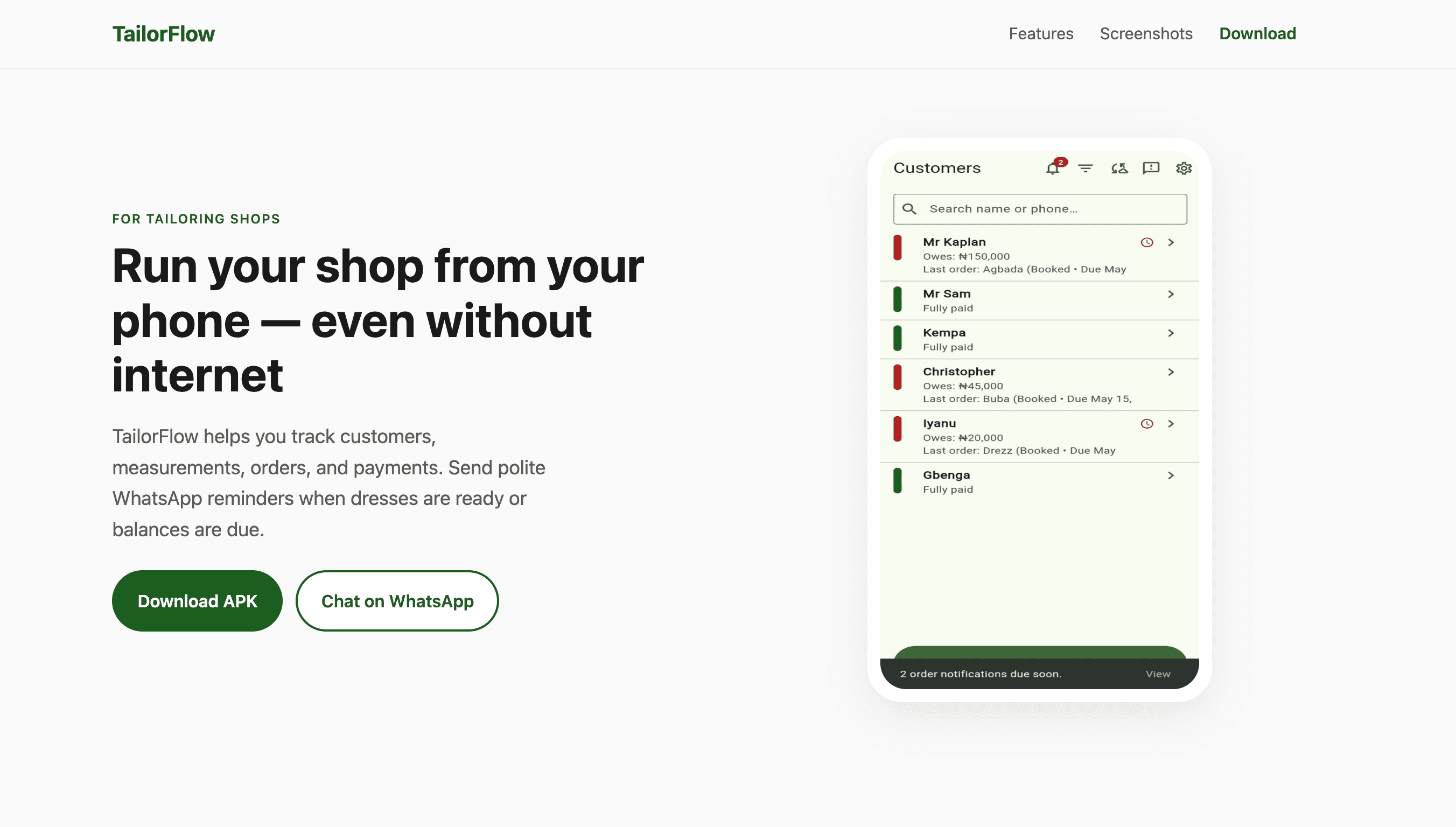
TailorFlow is an offline-first business management platform designed specifically for small tailoring businesses. The product helps tailors manage customer measurements, orders, payments, and communication from a single mobile application, while continuing to work even when internet connectivity is unavailable. Unlike traditional CRM or POS systems, TailorFlow was designed around the realities of small businesses in emerging markets, where connectivity is inconsistent and WhatsApp remains the primary customer communication channel.
The problem
Many tailoring businesses still rely on a combination of physical notebooks, memory, WhatsApp conversations, and loose paper records to manage critical customer information.
Lost measurements
Customer measurements are often stored manually and can be misplaced or become difficult to retrieve.
Poor order visibility
Tailors struggle to track across dozens of customers:
- Due dates
- Order status
- Outstanding balances
Inefficient communication
Most customer updates happen manually through WhatsApp, requiring repetitive messages and increasing the likelihood of forgotten follow-ups.
Connectivity constraints
Many existing business tools assume constant internet access, making them impractical for day-to-day use in environments with unreliable connectivity.
The goal
Build a mobile-first business operating system that enables tailoring shops to operate efficiently — while remaining simple enough for non-technical business owners.
- Manage customers efficiently
- Store measurement records securely
- Track orders and payments
- Communicate with customers easily
- Continue operating without internet access
My role
Founder & Lead Engineer
- Product strategy, user research, workflow design, and feature prioritization
- Mobile development — application architecture, state management, database design, UI implementation
- Backend design — sync architecture, cloud backup strategy, multi-tenant planning
- Business strategy — freemium model, pilot planning, privacy compliance considerations
Solution
TailorFlow centralizes a tailor's day-to-day operations into a single mobile application.
Customer management
Maintain customer records including:
- Names
- Phone numbers
- Notes
- Historical interactions
Measurement profiles
Store structured body measurements with historical tracking — eliminating dependency on paper measurement books.
Order management
Track throughout the lifecycle of an order:
- Style requests
- Fabric notes
- Delivery dates
- Production status
Payment tracking
Monitor revenue and reduce leakage:
- Deposits
- Outstanding balances
- Payment history
WhatsApp integration
Generate prefilled customer messages for pickup notifications, payment reminders, and follow-up requests — using the customer's existing WhatsApp workflow.
Optional cloud backup
When internet connectivity becomes available, data synchronizes to the cloud for backup and recovery.
Technical architecture
Frontend
- Flutter
- Dart
- Riverpod
Local data layer
- SQLite
- sqflite — source of truth; all critical operations work offline
Sync layer
- Connectivity Plus
- Outbox pattern — queue locally, sync when online
Cloud infrastructure
- Supabase
- Row-level security
- Tenant-aware data model
Monitoring
- Sentry — optional crash reporting and observability
Platform reach
- Android
- iOS
- Web
- Desktop — shared Flutter codebase
Architecture decisions
Offline-first by default
Most applications treat offline mode as an afterthought. TailorFlow was designed with offline functionality as a core requirement, significantly improving reliability in real-world usage.
Outbox synchronization pattern
Instead of coupling business workflows to network availability, user actions are persisted locally and synchronized later — improving reliability, reducing frustration, and building resilience to connectivity interruptions.
Multi-tenant foundation
Although initially targeted at individual shops, the architecture supports multiple businesses, membership management, and shared ownership models without requiring major redesign.
Privacy-by-design
Customer information is sensitive. The product was designed with privacy from the beginning, including documentation aligned with NDPR requirements.
Key challenges
Designing for non-technical users
The application needed to be simple enough for users with little or no technical experience. Balancing simplicity and functionality required significant UX iteration.
Maintaining data integrity offline
Offline-first workflows introduce challenges around synchronization, conflict resolution, and data consistency. The outbox architecture helped address these concerns.
Product-market alignment
Tailors do not think in terms of CRM systems. The product had to be designed around their actual workflow rather than forcing them into a generic business-management model.
Outcomes
Product validation
- Successfully developed a pilot-ready MVP capable of supporting real tailoring businesses.
Offline reliability
- Core workflows remain fully functional without internet connectivity.
Platform reach
- Built to support Android, iOS, Web, and Desktop from a shared Flutter codebase.
Business foundation
- Established a scalable architecture for future features including authentication, subscription billing, advanced reporting, and multi-shop collaboration.
Lessons learned
- Build around reality, not assumptions — designing around real-world constraints often creates greater value than adding more features.
- Offline-first is a product decision — for many users, it determines whether a product is usable at all.
- Vertical SaaS creates strong differentiation — specialized solutions tailored to a specific industry's workflow can create significantly more value than general-purpose software.
Impact
TailorFlow demonstrates my ability to identify underserved markets, design products around real-world operational constraints, and build scalable mobile systems that balance user experience, technical architecture, and business viability.